
Editorial approach: this is an educational explanation using illustrative exercises, not a record of a client deployment or a claim of tested commercial results. Check linked original sources before applying the methods to sensitive information.
An AI agent is a system that can use a language model to decide or coordinate steps toward a task, potentially calling tools and responding to intermediate results. Its value depends on the task, permissions, checks and available evidence—not on how autonomous it appears.
01. Strategic Opportunity: agents versus ordinary workflows
A scripted workflow follows steps specified in advance; an agentic system may allow a model to decide which action or tool call should happen next. Anthropic's engineering guidance distinguishes predetermined workflows from dynamically directed agents and recommends adding complexity only where the task requires it. ANTHROPIC
The distinction matters to a manager evaluating a proposed implementation. A predictable series of approval emails may need only ordinary automation. An open-ended document investigation, where the next source depends on previous findings, may justify an agent-like loop if access and validation can be controlled. Calling a chatbot an “agent” does not establish that it can safely take external actions.
02. Learning outcomes: understand the components
A useful agent design separates goal, instructions, model, tools, state, permissions, evaluator and human oversight. A tool connects the system to an allowed operation, such as searching a designated document store or writing to a sandbox. State tracks information needed between steps. Evaluation checks whether the work meets specified requirements. The OpenAI Agents SDK documents agents, tools, handoffs, guardrails and tracing as composable features. AGENTS
The model's suggested action is not itself authorization. Authorization must come from application logic, identity controls and explicit human approvals appropriate to the operation. Keep model-generated plans and real-world permissions separate.
03. Practical learning pathway
Hypothetical example — public research assistant: A user asks for a comparison of publicly available educational materials. The system selects a query, retrieves candidate pages from an authorized source, extracts relevant passages, and produces a draft table with links. A reviewer validates the passages and decides which claims can be accepted. If sources conflict, the agent flags the conflict instead of hiding it.
This is a teaching scenario, not a functioning deployment. An unsupervised version that automatically sends conclusions to third parties would require additional authority, privacy review and reliability testing.
Primary learning CTA proposal: Explore AI Implementation → /ai-implementation/.
04. Distinctive advantage: annotated agent architecture
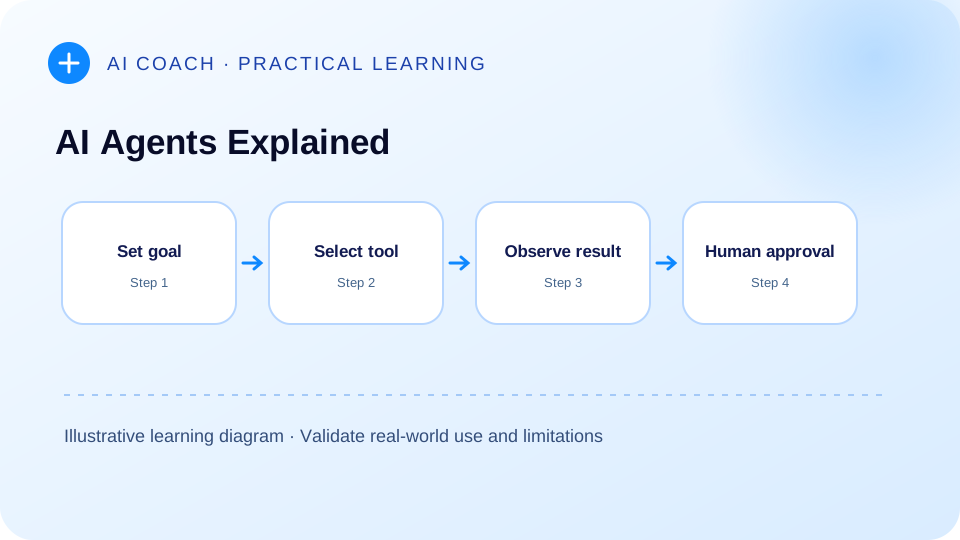
Original conceptual diagram specification: User goal → policy/identity check → model plan → permitted tool selection → tool execution → observation → evaluator → either revised step, human escalation or verified final output. All potentially irreversible actions pass through a separate authorization gate; tracing records the sequence.
This diagram shows a safer planning structure, not a claim that any individual toolkit supplies every necessary protection by default. To understand an agent, ask who can change the tool inventory, who checks parameters, which data the tools can access, and how the system stops when an objective is unclear.
05. Credibility and operational evidence
The OpenAI Agents SDK provides guardrail mechanisms and tracing capabilities, but its documentation explains that guardrails attach at different points in a workflow; a top-level output check does not automatically cover every tool call or delegated operation. GUARDRAILS TRACING
OWASP lists prompt injection as a major risk for LLM applications. Untrusted external text can seek to redirect an agent or induce unauthorized behavior. Mitigations include separating trusted instructions from untrusted data, least-privilege access, validation and human approval for high-risk actions. OWASP
The existence of an SDK, trace or guardrail feature does not demonstrate that a particular installation is secure. Risks must be evaluated against actual tool permissions, deployment configuration and observed tests.
06. Learning experience: build a bounded simulation
Before connecting live tools, simulate an agent with three fictional documents and a read-only search tool. Give it one research goal, require source passages for each conclusion, and record which tool call it proposes after every step. A human reviewer decides whether the proposed action is allowed. Introduce one irrelevant or misleading document and observe whether the assistant notices the mismatch.
Original decision matrix:
| Situation | Usually start with | Why |
|---|---|---|
| Fixed, repeatable steps | Deterministic workflow | Easy to inspect and test |
| One drafted answer | Plain assistant | No external action necessary |
| Variable research steps | Constrained agent pilot | Next action may depend on findings |
| Sensitive external changes | Human-controlled workflow | Authorization and reversibility dominate |
| Unclear success criteria | Redesign the task first | Hard to judge a completed run |
The matrix provides editorial guidance; it is not a product benchmark.
Agent design exercise: a permission-bound research task
Suppose a learner designs a fictional assistant permitted to read only three public educational pages. The task is to produce a comparison of lesson prerequisites. The permitted tool is read-only search across those pages. No email, external posting, account modification or private file access is allowed. Write a tool contract that states which resources may be searched, what information may be returned, and which error response appears if the request falls outside the boundary.
Next, define three test requests: a valid comparison request, a request requiring material outside the source collection, and a malicious instruction embedded in one of the retrieved pages. For the second case, the acceptable answer should report missing coverage rather than invent a comparison. For the third, the application should treat the retrieved instruction as untrusted content, refuse unauthorized actions and continue only within the allowed task. These are proposed test cases, not measured safety results.
Evaluation and observability record
A practical test record contains run identifier, goal, tool permissions, source set, proposed actions, actual tool calls, outputs, verification findings, reviewer and final status. A trace can assist review by recording what happened, but a trace is not by itself a judgment that behavior was correct. Testers should compare the recorded actions with the permitted action set and with the requirements in the original task.
Human escalation is needed where an action affects accounts, personal data, external communications or another system's state. State the exact point of approval before implementation begins. A prompt that says “ask for permission” is not a substitute for an application-level authorization check.
Complexity assessment before building
Ask whether the next step can be specified in advance, whether the intended output can be checked objectively, and whether a wrong action is reversible. If every step is known, ordinary automation may be a better initial design. If a model needs to select among sources or tools as evidence unfolds, a constrained agent may be justified. If the task cannot be evaluated or access cannot be safely restricted, the project is not ready for autonomous operation.
A sensible learning sequence is to simulate the task without live tools, test against a written acceptance set, introduce controlled tool use, inspect failures, and only then consider broader integration. The existence of a capable model should not determine the system architecture in advance.
07. Decision accelerator: reliability, security and escalation
Are agents always more capable than workflows? No. Flexibility adds new failure modes and evaluation work. Can an agent execute tools without permission? A properly designed application should reject actions beyond its granted authority, regardless of what the model requests. Does retrieval eliminate prompt injection? No; retrieved documents themselves can carry untrusted instructions, as OWASP explains. OWASP
When should a run stop? When tools are unavailable, the authorization context changes, the goal becomes ambiguous, source evidence is insufficient, evaluation fails repeatedly or a proposed action exceeds permissions. Set explicit limits on retries and escalation routes before any production deployment.
A supervised pilot should measure task completion and error types on a defined test set. Do not claim reliable autonomy from a few polished demonstrations.
08. Strategic conversion: choose the simplest appropriate implementation
The practical next step is to compare a standard workflow, a tool-assisted assistant and a constrained agent against one real problem. Begin with the existing AI implementation learning hub. Explore AI Implementation → /ai-implementation/ (proposed CTA, not final approved wording).
Primary sources for fact-check and attribution
- AGENTS: https://openai.github.io/openai-agents-python/
- ANTHROPIC: https://www.anthropic.com/engineering/building-effective-agents
- GUARDRAILS: https://openai.github.io/openai-agents-python/guardrails/
- OWASP: https://genai.owasp.org/llmrisk/llm01-prompt-injection/
- TRACING: https://openai.github.io/openai-agents-python/tracing/
Continue your learning pathway
Review the foundational guide and connect this topic to the relevant learning resources.
Explore AI implementation