
Editorial approach: this is an educational explanation using illustrative exercises, not a record of a client deployment or a claim of tested commercial results. Check linked original sources before applying the methods to sensitive information.
AI-generated text can sound authoritative while mixing accurate and unsupported statements. Verification means identifying exactly what is claimed, finding the original evidence and deciding whether that evidence supports the claim in the relevant context. Here is a method you can document and repeat.
01. Strategic Opportunity: fluent answers still need evidence
A response may include correct background, a fabricated citation, an outdated statistic or a valid source interpreted too broadly. These errors need different remedies. Rewriting the prompt can improve clarity but cannot replace external evidence. NIST's generative AI risk profile describes risk considerations relevant to trustworthy use and evaluation; it is a governance reference rather than proof of accuracy for a particular model. NIST
Verifying a broad phrase such as “research shows AI improves performance” is difficult because the claim lacks population, intervention, outcome and date. Convert it into checkable units first. Ask who conducted the study, on which task, with what comparison, and what the published result actually reported.
02. Learning outcomes: trace each consequential assertion
You should learn to isolate claims, distinguish first-party product descriptions from independent validation, recognize dates and applicability, and communicate uncertainty. A claim can be true in one jurisdiction or product version and false or unsupported in another. Verification therefore records not only a source but its scope.
Start by labeling statements as (a) factual and externally checkable, (b) interpretation, (c) hypothetical example, (d) advice or recommendation, or (e) marketing assertion. A claim's category tells you what evidence it requires. A vendor's documentation can establish that the vendor describes a feature; it cannot by itself prove a buyer received that feature or that a performance outcome occurred.
03. A practical verification pathway
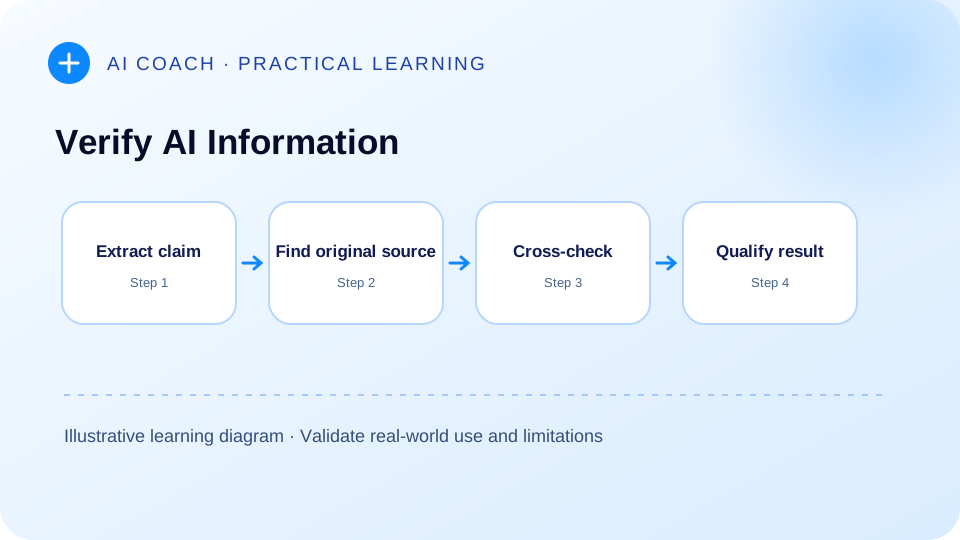
Step 1: Atomize. Break an AI paragraph into individual claims. Step 2: Identify the strongest likely source. Regulations require official law or agency records; scientific findings require original studies where accessible; tool features require current product documentation. Step 3: Open the original. Confirm authorship, publication date, version and relevant passage. Step 4: Compare. Determine whether the source actually supports the claimed subject, time, geography and strength. Step 5: Record. Classify the result as supported, qualified, unsupported, disputed or not yet verified.
Primary CTA proposal: Explore Research and AI Guides → /ai-guides-knowledge-hub/. This link is an existing educational destination, not a claim of a particular service's availability.
04. Original information gain: claim evidence ledger
A compact ledger can be used for research, purchasing decisions and educational publication:
| Field | Question answered |
|---|---|
| Claim | What exact proposition is being tested? |
| Source and publisher | Who provides the evidence? |
| Original passage | Where does the source address it? |
| Date/version | When and under which version is it applicable? |
| Scope | Which geography, sample or task is covered? |
| Support status | Supported, qualified, unsupported, disputed or unverified? |
| Review action | Publish as qualified, revise, exclude or escalate? |
A clear source URL is not enough: the passage must support the exact wording. If it does not, rewrite the claim or remove it.
05. Credibility: distinguish evidence types
Official standards can justify careful evaluation procedures but cannot establish that a particular company's feature performs as advertised. NIST's AI RMF is intended to improve how organizations consider trustworthiness, while OWASP provides application-security guidance concerning attacks such as prompt injection. These are different purposes. NIST_RMF OWASP
Illustrative worked assessment: Suppose a promotional paragraph claims that a document assistant “always gives correct answers.” An official feature page showing document-search capability establishes only that document search is offered. Without a reproducible independent evaluation over a defined test set, “always” is unsupported. A narrower statement—“the provider documents a document-search feature”—may be supportable after checking the version and source. This scenario is constructed, not a finding about a specific company.
06. Verification experience and escalation
Choose a short public-source AI summary. Underline all dates, figures, named entities, quotations and causal conclusions. Search for each original source; do not stop at another AI-generated summary that repeats the claim. If the primary material is inaccessible, record that as a limitation rather than inventing a substitute.
Distinguish absence of evidence from evidence of absence. Failure to find a supporting study does not prove a claim is impossible; it means the publication cannot responsibly present it as verified. Equally, a conflicting source needs to be evaluated for methodology and relevance, not dismissed because it is inconvenient.
Use a second reviewer for high-impact claims and log the final wording approved for publication. Review again when laws, models, company documentation or public datasets change.
An expanded worked verification case
Imagine a draft article states: “A new AI assistant is approved for use in every public hospital and consistently produces correct clinical summaries.” Break that into at least three claims: the product exists; a competent authority approved a particular use in a particular jurisdiction; and clinical summaries meet a defined accuracy criterion. A vendor homepage might support the first claim, but not the second or third. The approval claim requires the relevant regulator's record and exact intended use. The accuracy claim requires a properly described evaluation, population, comparator, result and limitations.
Until those additional sources exist, the combined sentence should not be published. If reliable evidence supports only the product's existence, describe the product narrowly. Do not convert missing evidence into a negative statement about the product either; simply mark the other claims unresolved. This example is fictional and is not an assessment of any real vendor.
Practical criteria for strength of support
A source directly supports a claim when it addresses the same entity, the same action or property, and the same scope. A source merely mentioning the subject is weak support. A dated policy superseded by a newer version may be unsuitable for a current compliance claim. A press release can substantiate what an organization announced, but not automatically demonstrate that a promised system was delivered. A peer-reviewed study may provide stronger methodological evidence for a specific result, yet still not justify extending that result to every population and context.
For each source record, retain the publisher, named author if available, title, publication or update date, retrieval date where useful, stable link, relevant passage and any caveat necessary to understand it. This makes corrections possible after new evidence appears.
Editorial quality-control exercise
Take one paragraph of an AI-produced report and create a table of every assertion. Rate its consequence as low, moderate or high in the intended publication context. Check high-consequence assertions first, then dates and numerical claims, then background definitions. Ask a second person to inspect at least one borderline or disputed assertion. Finally, produce a revised paragraph that uses only supportable wording. Keep the rejected sentence and reason in an internal record so the same wording is not reintroduced later.
The exercise demonstrates an important distinction: a document may be well written yet not publishable. Editorial polish measures readability; the evidence ledger measures support. Both are needed for a trustworthy educational article.
07. Decision accelerator: citations, screenshots and domain-sensitive checks
Can AI-generated citations be trusted automatically? No. Check that the work exists and supports the specific proposition. Does a screenshot verify a service is currently available? It may establish what appeared at the time of capture, but not present functionality or delivery quality. Can vendor testimonials prove a universal outcome? No; testimonials are not substitutes for representative evidence.
What about medical, legal and financial material? Preserve the original authoritative sources, current jurisdiction and appropriate professional review. A general explanatory article should not become individualized specialist advice. Also beware of source material containing instructions aimed at an AI assistant: OWASP documents how untrusted external content can influence model behavior. OWASP
When evidence conflicts, publish the limits of the finding rather than choosing a stronger-sounding conclusion.
08. Strategic conversion: better research decisions
Make claim-level verification part of every AI-assisted research workflow. Begin with a small ledger, review the highest-consequence assertions first, and retain the originals. Continue through Explore Research and AI Guides → /ai-guides-knowledge-hub/ (proposed CTA awaiting approval).
Primary sources for fact-check and attribution
- NIST: https://www.nist.gov/publications/artificial-intelligence-risk-management-framework-generative-artificial-intelligence
- NIST_RMF: https://www.nist.gov/itl/ai-risk-management-framework
- OWASP: https://genai.owasp.org/llmrisk/llm01-prompt-injection/
Continue your learning pathway
Review the foundational guide and connect this topic to the relevant learning resources.
Explore evidence-led guides