
Editorial approach: this is an educational explanation using illustrative exercises, not a record of a client deployment or a claim of tested commercial results. Check linked original sources before applying the methods to sensitive information.
Generative AI creates new text, images, audio, code, or other content by learning patterns from data. Understanding what it generates—and what it cannot establish—helps you use it with judgment. This guide offers a practical mental model, a comparison table, and a starter exercise rather than treating every model output as an established fact.
01. Strategic Opportunity: why the distinction matters
A modern AI assistant can draft an outline, summarize a source, suggest code, or transform notes into a structured format. These are examples of potential use rather than evidence of consistent accuracy or verified productivity improvements. A useful starting point is to distinguish generating plausible material from retrieving a verified fact. The former is a capability; the latter is an evidence task. OpenAI Academy organizes introductory learning around AI fundamentals and responsible use, reinforcing the importance of both capability and judgment. ACADEMY
A learner might ask for an explanation of a technical term, a summary of a public policy, and a recommendation about a sensitive decision. Those tasks differ: the explanation can be an educational starting point; the summary requires comparison with its original source; the sensitive recommendation requires qualified human review. The prompt alone does not change those standards.
02. What you will be able to understand
By the end, you should be able to distinguish generative from predictive tasks; describe the input-to-output sequence; recognize why a fluent sentence can still be wrong; classify suitable starter activities; and identify when original documents or specialist review are necessary. These are learning objectives, not promises that one article creates professional competence.
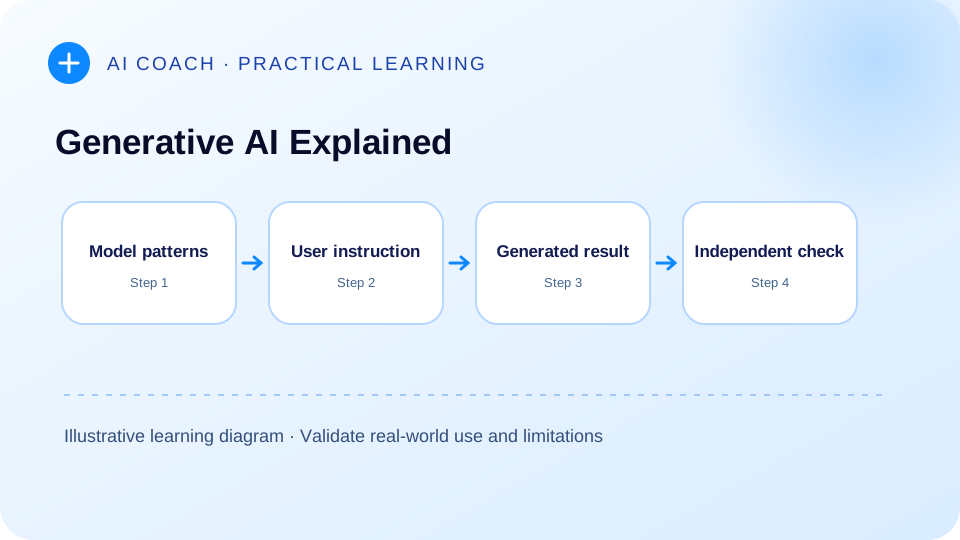
A simple model: input → tokenization or other representation → learned model computation → candidate output → human or automated evaluation. For text systems, many language models estimate relationships among tokens from training patterns and the context supplied during a request. Their outputs are generated, not retrieved from an authoritative database by default. Tools and retrieval systems may add external information, but they need separate evaluation.
03. A practical beginner learning pathway
Start by identifying the form of the material you want. Text generation is suitable for rephrasing your own notes or building a first draft. Structured extraction may be useful for organizing a document, provided you compare every extracted field with the original. Image generation may produce concepts for illustration but should not be represented as documentary proof. Code assistance can propose code that must be inspected and tested.
A reasonable starter activity uses non-sensitive material you are entitled to share. Supply a three-paragraph public-domain or self-authored text, ask for five key points, and compare every point with the original. Mark omissions and unsupported additions. Then ask the model to display an uncertainty or source-needed column. This exercise teaches the difference between a readable response and a verified one.
Primary learning action: Explore AI Foundations — /learn-ai/.
04. Why this explanation is useful
It separates three often-confused categories: the model's technical capability, the workflow around the model, and the trustworthiness of a specific answer. A good workflow can improve reviewability even when the model remains fallible. A retrieval layer, for example, can provide relevant documents; it does not automatically guarantee that the generated answer accurately represents those documents. Critical outputs require source-by-source verification.
Original comparison — task, benefit and limitation
| Task type | Illustrative request | What to evaluate |
|---|---|---|
| Creation | Draft a lesson outline | Clarity, omissions, originality |
| Transformation | Rewrite a supplied paragraph | Meaning preserved, no added facts |
| Extraction | List dates in a supplied memo | Matches to original text |
| Explanation | Explain a scientific concept | Technical correctness against references |
| Decision support | Compare candidate approaches | Assumptions, missing evidence, professional oversight |
05. Credibility and evidence
Generative AI should be interpreted through documented system behavior and risk standards rather than slogans. The US National Institute of Standards and Technology published a generative AI risk profile as a companion to its AI Risk Management Framework. It addresses risks throughout design, development, use and evaluation. NIST NIST_RMF
One common misconception is that longer or more confident answers are more reliable. Neither length nor confident wording provides independent validation. A second misconception is that every AI application requires the same level of review. Routine low-consequence formatting and a clinical, legal or financial assertion present very different stakes. A third is that a model with access to a document cannot misdescribe it; supplied content must still be checked against the output.
06. How to practise responsibly
Create a two-column notebook: one side records the model's assertion and the other records the source passage or observation that supports it. Avoid entering confidential records without authorization and review the privacy terms of the service you use. For technical examples, test whether the proposed procedure actually works before relying on it.
A learner's four-step loop is ask → inspect → verify → revise. In the inspect stage, look for missing qualifiers, invented references, numbers without provenance, and claims stated more strongly than the input allows. In verify, compare the output with original documents or relevant tests. In revise, correct the input and ask for clearer distinctions—but do not mistake repeated model agreement for external confirmation.
Suggested progression: first learn foundational definitions; then practise prompting with a stable task; next learn a source-verification protocol; only then attempt connected workflows or agentic systems. This progression is editorial guidance, not a validated universal learning sequence.
Further worked examples: identifying the real evidence task
Example A — summarize a public report. Suppose a reader supplies an annual report and requests its principal themes. The model can propose a summary, but the reader should compare claims against the specific pages that contain them. A quoted figure must retain its unit, year, denominator and caveats. If the report describes projected activity, it must not become a claim of completed activity. A summary without traceable passages is a reading aid, not a verified executive briefing.
Example B — generate a course outline. Ask for a beginner lesson explaining the difference between predictive analytics and content generation. A proposed outline may help organize teaching, but each technical proposition should be checked against educational or technical documentation. Mark examples as examples. Do not pretend that the outline is a certified curriculum or that completing it creates a qualification.
Example C — classify an internal document. Classification looks simpler than open-ended writing, yet it can fail when categories overlap or instructions are ambiguous. Define the permitted labels first, test them on documents whose correct labels a human has already determined, and keep a separate category for uncertain cases. Without a reference set, a persuasive-looking result cannot establish classification quality.
A useful learner reflection asks four questions after each example: What was created? Which content was supplied by the user? Which claims need original evidence? What would make this output unsuitable for actual use? Keep the answers alongside the output. This transforms a one-off demonstration into a reproducible learning process.
A decision check for new learners
Before choosing a model, write down the decision that the output would inform. If you only want to explore language or structure, a provisional draft may be adequate. If the answer affects a person's rights, safety, employment or sensitive information, increase the evidence, access and reviewer requirements. If the information is unavailable, mark it unknown instead of asking the model to fill the gap. This distinction matters more than whether the interface appears impressive.
07. Decisions, limitations and frequently asked questions
Is generative AI the same as machine learning? No. Machine learning is a broader set of methods that learn patterns from data; generative models are a class of systems used to produce new content. Is every generated response original? Do not assume it is unique, free from protected material, or suitable for reuse without checking rights and context. Does a citation make a response correct? No; the cited document has to exist and support the precise claim.
When should you avoid using it? When there is no lawful or secure basis to supply the input, when required source accuracy cannot be established, or when a decision calls for licensed professional judgment. For personal learning, choose exercises where errors can be detected before anything important depends on the result. Information that changes quickly should carry a review date and source record.
08. Strategic conversion: the next learning step
Generative AI becomes easier to evaluate when you can name the task, choose the right evidence, and check the output. The appropriate next step is a foundational lesson followed by a small, reproducible exercise. Explore AI Foundations at /learn-ai/. Do not interpret this link as enrollment in a course that has not been independently confirmed.
Primary sources for fact-check and attribution
- ACADEMY: https://openai.com/academy/ai-fundamentals/
- NIST: https://www.nist.gov/publications/artificial-intelligence-risk-management-framework-generative-artificial-intelligence
- NIST_RMF: https://www.nist.gov/itl/ai-risk-management-framework
Continue your learning pathway
Review the foundational guide and connect this topic to the relevant learning resources.
Continue learning AI